
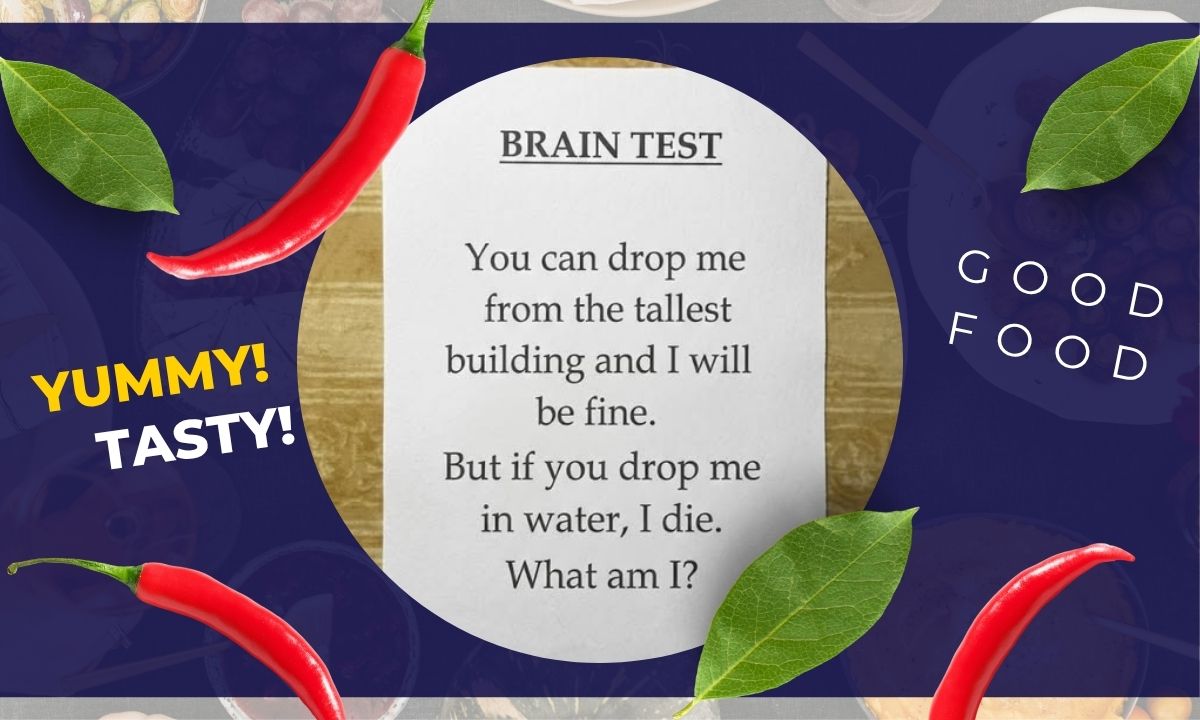
The internet loves a good mystery, especially one that fits on a single scrap of paper. Recently, a classic riddle has resurfaced, challenging users to think outside the box and reconsider the physical properties of everyday objects.
The riddle reads:
“You can drop me from the tallest building and I will be fine. But if you drop me in water, I die. What am I?”
If you’re scratching your head, you aren’t alone. While the answer is deceptively simple, the logic behind it requires a shift in how we perceive strength and vulnerability.
The Answer: Paper
The answer to this “Brain Test” is Paper. At first glance, paper seems like a fragile material—you can rip it with your bare hands, after all. However, when it comes to the physics of falling, paper has a unique advantage that makes the riddle work perfectly.
Why the Tallest Building Doesn’t Matter
If you were to drop a glass vase or a smartphone from the top of a skyscraper, the result would be catastrophic. The force of gravity accelerating a heavy, rigid object leads to a high-impact collision with the ground.
Paper, however, plays by different rules:
- Low Mass and High Surface Area: Because a sheet of paper is so light and flat, it has a very low terminal velocity. Instead of plummeting, it catches the air, fluttering and drifting slowly to the ground.
- Flexibility: When it eventually lands, the impact force is negligible. It doesn’t shatter or break because its structure is flexible and its weight is insufficient to cause self-destruction upon landing. It remains perfectly intact, “fine” as the riddle suggests.
The Fatal Flaw: Why Water is the Enemy
While height can’t hurt paper, chemistry can. Paper is made of cellulose fibers held together by hydrogen bonds. When paper is submerged in water, the water molecules wedge themselves between these fibers, breaking the bonds that give the paper its shape and strength.
- Structural Collapse: Once wet, paper loses its integrity. It becomes “mush,” essentially “dying” as it can no longer function as the object it once was.
- Irreversibility: While you can dry paper out, it is almost never the same. It crinkles, warps, and the ink often runs, signifying the end of its original state.
Why Our Brains Struggle with This Riddle
Psychologically, we are conditioned to associate “danger” with “height.” Evolutionarily, a fall from a great height is one of the most significant threats to a human being. Riddles like this work by exploiting our cognitive biases. We assume that if a tall building can’t kill “it,” then “it” must be incredibly tough—like a diamond or a piece of steel.
By the time we reach the second half of the riddle, our brain is looking for something indestructible, which makes the mention of “water” a total curveball.
The Takeaway
The “Paper Riddle” is a brilliant reminder that strength is relative. Something can be “strong” enough to survive a 1,000-foot drop but “weak” enough to be destroyed by a single glass of water. It’s all about the environment.