
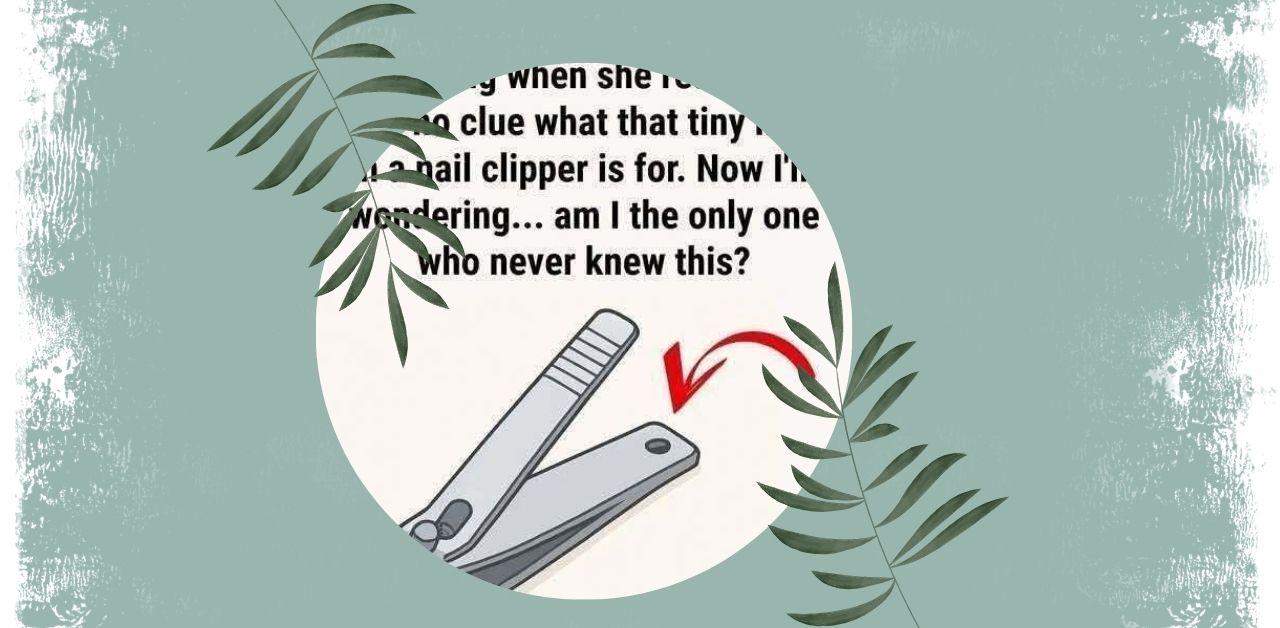
Nail clippers are one of those everyday tools that most people use without giving much thought to their design. They sit in bathroom drawers, travel kits, and grooming sets, quietly performing their job of keeping nails neat and tidy. Yet, tucked into their simple design is a small detail that often goes unnoticed: the tiny hole near the lever. Many people see it, wonder about it, and then move on without ever discovering its function. This little feature, however, is not a meaningless quirk of manufacturing—it has a practical purpose that reflects the thoughtful engineering behind even the simplest tools.
The hole is positioned at the end of the lever, opposite the curved cutting blades. At first glance, it might seem decorative or perhaps a way to reduce material weight. In reality, it serves as a pivot point. Nail clippers are designed with a removable lever that can be rotated and reattached. To assemble or disassemble the clipper, the lever is aligned with the hole and pressed into place. This allows the lever to lock securely, giving the user the mechanical advantage needed to cut through tough fingernails or toenails with minimal effort. Without this hole, the lever would not be able to snap into position, and the clipper would lose its functionality.
Beyond its role in assembly, the hole also provides versatility. Some clippers are designed with small rods or pins that can be inserted through the hole, turning the clipper into a keychain accessory. This makes it easy to carry a clipper while traveling, ensuring that personal grooming is never neglected. Others use the hole as a way to hang the clipper on hooks or bathroom organizers, keeping it accessible and preventing it from getting lost in drawers.
The design of nail clippers dates back to the late 19th and early 20th centuries, when inventors sought to improve upon scissors and knives for trimming nails. The lever-and-blade mechanism was revolutionary because it allowed for precise cuts without requiring much strength. The tiny hole was part of that innovation, enabling the lever to be detachable and reassembled with ease. Over time, the design became standardized, and nearly all modern clippers feature this hole, even if users rarely notice it.
From a mechanical perspective, the hole is a clever solution to a common problem: how to create a compact tool that can generate enough force to cut through keratin, the tough protein that makes up nails. By placing the lever into the hole, the clipper harnesses the principle of leverage, multiplying the force applied by the user’s fingers. This is why even a small clipper can cut thick toenails without difficulty.
In daily life, the hole may not be something people think about, but it represents the hidden intelligence of design. It is a reminder that even the simplest objects are the result of careful engineering, where every part has a purpose. The next time you pick up a nail clipper, take a moment to notice that tiny hole. It is not just an empty space—it is the key to the tool’s functionality, portability, and durability.
Conclusion
The tiny hole in nail clippers is more than a curiosity. It is a functional pivot point that allows the lever to lock into place, ensuring the clipper works effectively. It also provides secondary uses, such as attaching the clipper to a keychain or hanging it for storage. This small detail reflects the ingenuity of everyday design, showing that even the most ordinary tools carry hidden features worth appreciating.